On this page
One of the most expensive misunderstandings in UAE tax compliance is the assumption that a free zone company does not need to worry about VAT. Many business owners sign a lease in DMCC, IFZA or Meydan believing their sales sit outside the UAE tax system, only to discover during an FTA audit that they should have been charging 5% VAT all along.
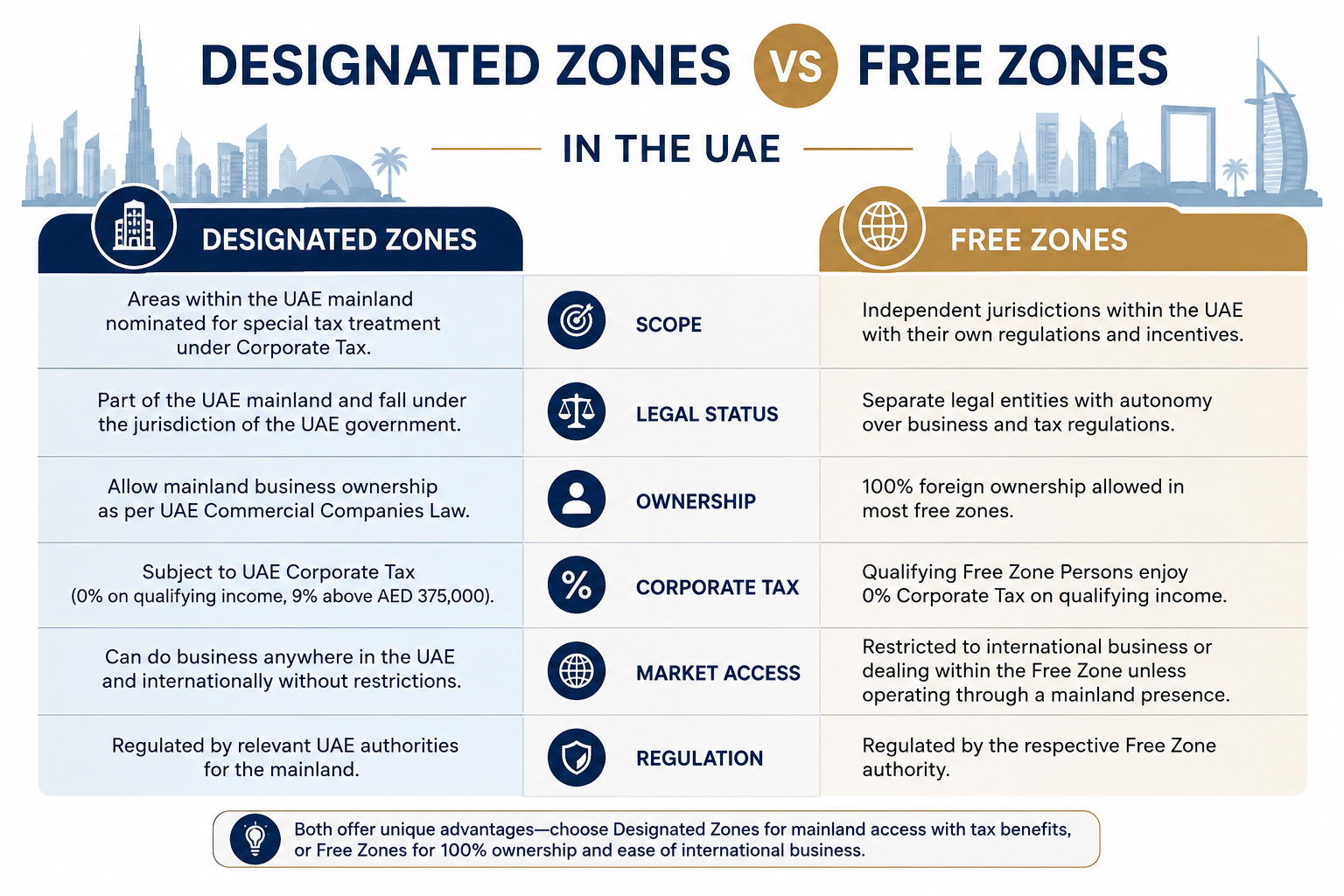
The confusion comes from mixing up two different concepts. A free zone is a licensing and company formation concept. A designated zone is a VAT concept. Every designated zone is a free zone, but most free zones are not designated zones, and the difference determines how VAT applies to your transactions.
This guide explains what separates the two, which zones currently qualify, how VAT applies to goods and services in each case, and how designated zone status connects to the UAE Corporate Tax regime.
Free zone — a licensing concept
- An economic area with its own licensing authority
- 100% foreign ownership and simplified setup
- For VAT, most are treated exactly like the mainland
Designated zone — a VAT concept
- A free zone specifically listed by the UAE Cabinet
- Fenced, customs-controlled, FTA-compliant
- Outside the UAE for VAT, for certain goods transactions only
The short answer
A free zone is an economic area with its own licensing authority, offering benefits such as 100% foreign ownership and simplified setup. There are more than 40 free zones across the UAE. For VAT purposes, the vast majority of them are treated exactly like the mainland.
A designated zone is a free zone that the UAE Cabinet has specifically listed under Cabinet Decision No. 59 of 2017 (as amended) because it meets strict customs and security conditions. A designated zone is treated as outside the UAE for VAT purposes, but only for certain transactions in goods. Services supplied in designated zones follow normal UAE VAT rules and are typically taxable at 5%.
In practical terms:
| Free Zone (non-designated) | Designated Zone | |
|---|---|---|
| Legal basis | Zone-specific licensing regulations | Cabinet Decision No. 59 of 2017, as amended, under Article 51 of the VAT Executive Regulations |
| VAT treatment of goods | Same as mainland (generally 5%) | Certain goods transactions can be outside the scope of VAT |
| VAT treatment of services | 5%, unless zero-rated or exempt by law | 5%, unless zero-rated or exempt by law. No zone benefit |
| VAT registration | Required above AED 375,000 taxable turnover | Required above AED 375,000 taxable turnover |
| Examples | DMCC, IFZA, Meydan, ADGM, DIFC | JAFZA, DAFZA, KIZAD, Hamriyah, SAIF Zone |
In short
Designated zone benefits apply to goods under customs control, never to services, and never automatically.
What is a free zone?
Free zones were established to attract investment and simplify business setup. They offer:
- 100% foreign ownership
- Independent licensing authorities
- Modern infrastructure and industry-specific clusters
However, free zone status does not change how VAT applies. For VAT, most free zones are treated exactly like the mainland. A consultancy in DMCC, IFZA, Meydan, DIFC or ADGM must charge VAT exactly as a mainland business would.
What is a designated zone?
A designated zone is a free zone that meets strict criteria under Article 51 of the VAT Executive Regulations:
- A clearly fenced geographic area
- Customs and security controls monitoring goods and people
- Internal procedures for storing and processing goods
- Full compliance with FTA requirements
Only zones listed in Cabinet Decision No. 59 of 2017 (as amended) qualify. The list changes — zones can be added or removed — so always check the latest FTA publication.
Importantly, the benefit applies transaction by transaction, not automatically to the company.
Which UAE free zones are designated zones?
The following zones have been listed under Cabinet Decision No. 59 of 2017 and its amendments. The list below reflects the commonly cited designated zones by emirate; because the Cabinet can add or remove zones, verify against the FTA's current published list before structuring transactions around it.
| Emirate | Designated Zones |
|---|---|
| Abu Dhabi | Free Trade Zone of Khalifa Port; Abu Dhabi Airport Free Zone; Khalifa Industrial Zone (KIZAD) |
| Dubai | Jebel Ali Free Zone (JAFZA); Dubai Cars and Automotive Zone (DUCAMZ); Dubai Textile City; Free Zone Area in Al Quoz; Free Zone Area in Al Qusais; Dubai Aviation City; Dubai Airport Free Zone (DAFZA) |
| Sharjah | Hamriyah Free Zone; Sharjah Airport International Free Zone (SAIF Zone) |
| Ajman | Ajman Free Zone |
| Umm Al Quwain | Umm Al Quwain Free Trade Zone in Ahmed Bin Rashid Port; Umm Al Quwain Free Trade Zone on Sheikh Mohammed Bin Zayed Road |
| Ras Al Khaimah | RAK Free Trade Zone; RAK Maritime City; RAK Airport Free Zone |
| Fujairah | Fujairah Free Zone; Fujairah Oil Industry Zone (FOIZ) |
Notably not designated zones
DMCC, DIFC, ADGM, IFZA, Meydan, Dubai Internet City, Dubai Media City, SHAMS, RAKEZ business zones outside the customs-controlled areas, and most other popular free zones. Companies in these zones follow mainland VAT rules in full.
The pattern is logical. Designated zones are almost always industrial, logistics or port-based environments.
VAT on goods: where the difference actually matters
Designated zone benefits apply only to goods that remain under customs control. This is how VAT treats goods moving between the three territories — every treatment below is conditional on customs control and documentation.
| Movement of goods | VAT treatment |
|---|---|
| Rest of world → Designated zone | No import VAT at entry |
| Designated zone → Designated zone | Out of scope (under customs control) |
| Within a designated zone | Out of scope (goods, conditions apply) |
| Designated zone → Abroad | Zero-rated export (0%) |
| Designated zone → UAE mainland | Import, 5% VAT |
| UAE mainland → Designated zone | 5% domestic supply |
Goods transactions involving designated zones
| Transaction | VAT Treatment | Condition |
|---|---|---|
| Sale of goods within one designated zone | Outside the scope of VAT | Goods are not consumed in the zone and remain under customs control |
| Transfer of goods between two designated zones | Outside the scope of VAT | Movement is under customs supervision with proper documentation; the FTA may require a guarantee |
| Import of goods from abroad into a designated zone | No import VAT at entry | Goods stay in the zone or move to another designated zone under customs control |
| Sale of goods from a designated zone to a customer outside the UAE | Zero-rated export (0%) | Valid export documentation retained |
| Goods moved from a designated zone into the UAE mainland | Treated as an import into the UAE; VAT applies at 5% | Import VAT accounted for by the importer, typically via the VAT return under the reverse charge where registered |
| Sale of goods from the mainland into a designated zone | Taxable at 5% | This is a domestic supply, not an export |
| Goods consumed or used within a designated zone | Taxable | Consumption inside the zone is treated as if the goods entered the UAE |
Two of these rows catch businesses out repeatedly.
Not an export
Mainland to designated zone is not an export. A mainland supplier selling equipment to a JAFZA company must charge 5% VAT. The designated zone regime helps goods coming from outside the UAE or circulating between designated zones. It does not turn domestic purchases into exports.
Consumption kills the benefit
If a designated zone company buys goods VAT-free and then uses them itself — office equipment, consumables, items given away as samples — those goods are treated as having entered UAE consumption and VAT becomes due. The exception is where goods are consumed in producing or selling other goods within the zone.
A 2021 amendment to Article 51 (Cabinet Decision No. 88 of 2021) also refined the rules for goods sold through e-commerce platforms and related shipping arrangements from designated zones. If your business sells goods online from a designated zone, this is an area where specific advice is worth the cost, because the conditions are narrow and technical.
Goods in non-designated free zones
There is no special regime. A trading company in a non-designated free zone charges 5% VAT on sales within the UAE, zero-rates genuine exports with proper documentation, and pays or self-accounts for import VAT like any mainland business.
A worked example
Suppose a JAFZA trading company imports electronics worth AED 1,000,000 from China.
| Stage | VAT position |
|---|---|
| On arrival into JAFZA: goods sit under customs control in the zone | No import VAT due |
| AED 400,000 sold to another JAFZA company, goods staying in the zone | Outside the scope of VAT |
| AED 300,000 exported to Saudi Arabia, customs export documentation retained | Zero-rated (0%) |
| AED 300,000 sold to a Dubai mainland retailer; the goods leave the zone and enter the UAE | Import VAT at 5% on entry |
VAT on services: no difference at all
This deserves its own section because it is the single most common error.
Services are always within normal VAT rules
Services supplied in, from, or into a designated zone follow normal UAE VAT rules. Article 51 treats a designated zone as inside the UAE for services.
That means:
- Consultancy, marketing, IT, logistics handling, warehousing fees, and rent charged between two companies inside the same designated zone: 5% VAT
- Services supplied from a designated zone to a mainland customer: 5% VAT
- Services supplied to a customer outside the UAE: potentially zero-rated, under the same export-of-services conditions that apply to every UAE business (broadly, the recipient has no place of residence in the UAE and is outside the UAE when the service is performed, among other conditions in Article 31 of the Executive Regulations)
A warehouse operator in DAFZA charging storage fees to a tenant in the same zone must charge 5% VAT, even though the goods sitting in that warehouse may be entirely outside the scope. The goods and the service attached to them are treated differently. Invoicing systems need to handle both correctly on the same transaction.
VAT registration: the rules are the same everywhere
Zone status has no effect on registration obligations. Wherever your company is established:
- Mandatory registration applies once taxable supplies and imports exceed AED 375,000 over the previous 12 months, or are expected to exceed it in the next 30 days
- Voluntary registration is available above AED 187,500 of taxable supplies or taxable expenses, which lets earlier-stage businesses recover input VAT
- Registration is completed through the FTA's EmaraTax portal
- Late registration currently attracts an administrative penalty of AED 10,000, on top of any VAT the FTA assesses retrospectively
One nuance for designated zone businesses: supplies that are outside the scope of VAT do not count toward the registration threshold. A company trading purely within designated zones under customs control may not cross the mandatory threshold. But the moment it makes taxable supplies — services, mainland sales, consumed goods — those count, and many designated zone companies register voluntarily in any case to recover VAT on rent, utilities and overheads.
Documentation: what keeps the benefit alive
The FTA does not take designated zone treatment on trust. Out-of-scope treatment survives an audit only if the paper trail proves the goods stayed under customs control. In practice that means:
- Customs declarations for entry into and exit from the zone
- Transfer documentation for movements between designated zones, including any guarantees required by the FTA
- Commercial invoices matching the customs records
- Inventory records that reconcile what came in, what went out, and what remains
- Evidence of export (bills of lading, airway bills, exit certificates) for zero-rated sales
- Records retained for at least 5 years (longer retention applies to real estate records)
Where documentation is missing or inconsistent, the FTA can reclassify out-of-scope supplies as taxable, assess the VAT, and add penalties. For a goods business with thin margins, a reclassification across several years of transactions can be existential. The compliance discipline is not optional overhead; it is the price of the regime.
The corporate tax connection
Since UAE Corporate Tax took effect for financial years starting on or after 1 June 2023 (Federal Decree-Law No. 47 of 2022), designated zone status has gained a second layer of importance.
A free zone company that meets the conditions to be a Qualifying Free Zone Person (QFZP) pays 0% corporate tax on its qualifying income and 9% on the rest. The list of qualifying activities is set by Ministerial Decision No. 229 of 2025 (which replaced Ministerial Decision No. 265 of 2023, with effect from 1 June 2023), read with Cabinet Decision No. 100 of 2023.
One qualifying activity is defined specifically by reference to designated zones: "distribution of goods or materials in or from a Designated Zone." Broadly, a trading business buying and selling goods to customers who resell them (or process them for resale) can treat that income as qualifying, provided the activity is conducted in or from a designated zone and, where foreign goods are supplied to UAE customers outside a designated zone, the goods are imported through a designated zone.
The practical consequence: for goods distribution businesses, being in JAFZA rather than a non-designated zone can mean the difference between 0% and 9% corporate tax on distribution income, on top of the VAT cash flow benefits. It also means VAT records, customs records and corporate tax positions all need to tell the same story. An inconsistency in one regime can unravel the position in the other.
QFZP status carries further conditions — adequate substance in the zone, audited financial statements, the de minimis limit on non-qualifying revenue, and compliance with transfer pricing rules among them — and failing them means losing the 0% rate for the current period and the following four tax periods. This is not a status to assume casually. It should be assessed properly and monitored.
Choosing between a designated zone and a regular free zone
The right answer depends on what your business actually does.
A designated zone tends to make sense if you
- Import, store and re-export physical goods
- Distribute goods to resellers in the UAE or the wider region
- Need to defer import VAT for cash flow reasons
- Want to align a goods distribution model with the 0% corporate tax qualifying activity
A regular free zone is usually the better fit if you
- Provide services — there is no VAT advantage in a designated zone, and designated zones are often industrial locations with higher logistics-oriented costs
- Sell mainly to mainland UAE consumers, since the VAT benefit largely disappears once goods enter the mainland
- Value a specific ecosystem, such as commodities in DMCC or financial services in DIFC or ADGM
Neither status matters much if
- Your revenue is below the VAT registration threshold and you have no goods movements, in which case setup cost, license scope and location should drive the decision
Zone selection is one of the few tax decisions that is genuinely hard to change later. Moving a company between zones means new licenses, new leases, customs re-registration and often a new bank compliance review. It is far cheaper to get it right at setup.
Common mistakes to avoid
- Assuming free zone means VAT free. Most free zones have no special VAT treatment at all.
- Not charging VAT on services inside a designated zone. Services are always within normal VAT rules.
- Treating mainland purchases as exports. Mainland to designated zone supplies carry 5% VAT.
- Consuming goods in the zone without accounting for VAT. Consumption triggers VAT even inside a designated zone.
- Missing registration deadlines. The AED 375,000 threshold applies regardless of zone, and the late registration penalty is AED 10,000.
- Weak customs documentation. Without it, out-of-scope treatment collapses under audit.
- Ignoring the reverse charge on imported services. A free zone company buying services from abroad must self-account for VAT if registered.
- Managing VAT and corporate tax in isolation. For designated zone distributors, the two regimes now depend on the same facts and records.
Key takeaway
Key takeaway
Free Zone status determines where your business is licensed, while Designated Zone status determines how VAT applies to the movement of your goods. Only a specific list of customs-controlled zones qualifies, and the VAT benefit attaches to eligible goods under strict customs supervision, not to the company itself. All services remain fully taxable, and VAT registration rules are uniform across the UAE. For distribution and trading businesses, Designated Zone classification now also directly supports the 0% corporate tax position, making precise documentation and consistent control over inventory movements more critical than ever.
How Holistic Solutions can help
Zone selection, VAT classification and QFZP eligibility are decisions where the details determine the outcome, and where an error compounds quietly for years before an audit surfaces it. Holistic Solutions advises businesses across the UAE on choosing the right structure at setup, registering for VAT and Corporate Tax, classifying transactions correctly, and building the documentation discipline that keeps designated zone benefits intact.
If you are setting up in the UAE and weighing a designated zone against a regular free zone, or you already operate in a free zone and want certainty about your VAT and corporate tax position, speak to Holistic Solutions. A short conversation before you commit costs far less than restructuring after. Fixed fees agreed up front, and one team across company formation, VAT and corporate tax.